
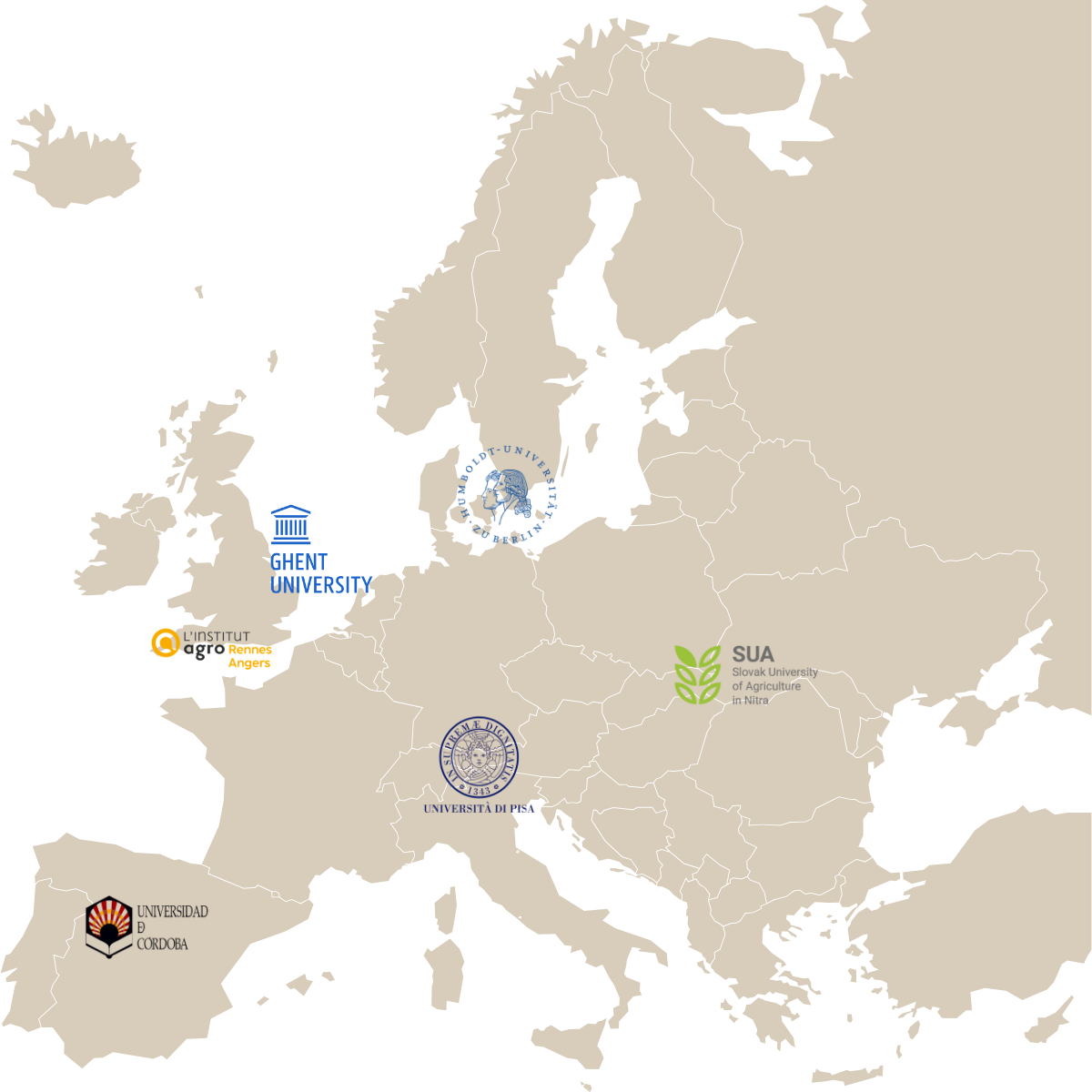
Belgium
Spain
Germany
Slovakia
Italy
France
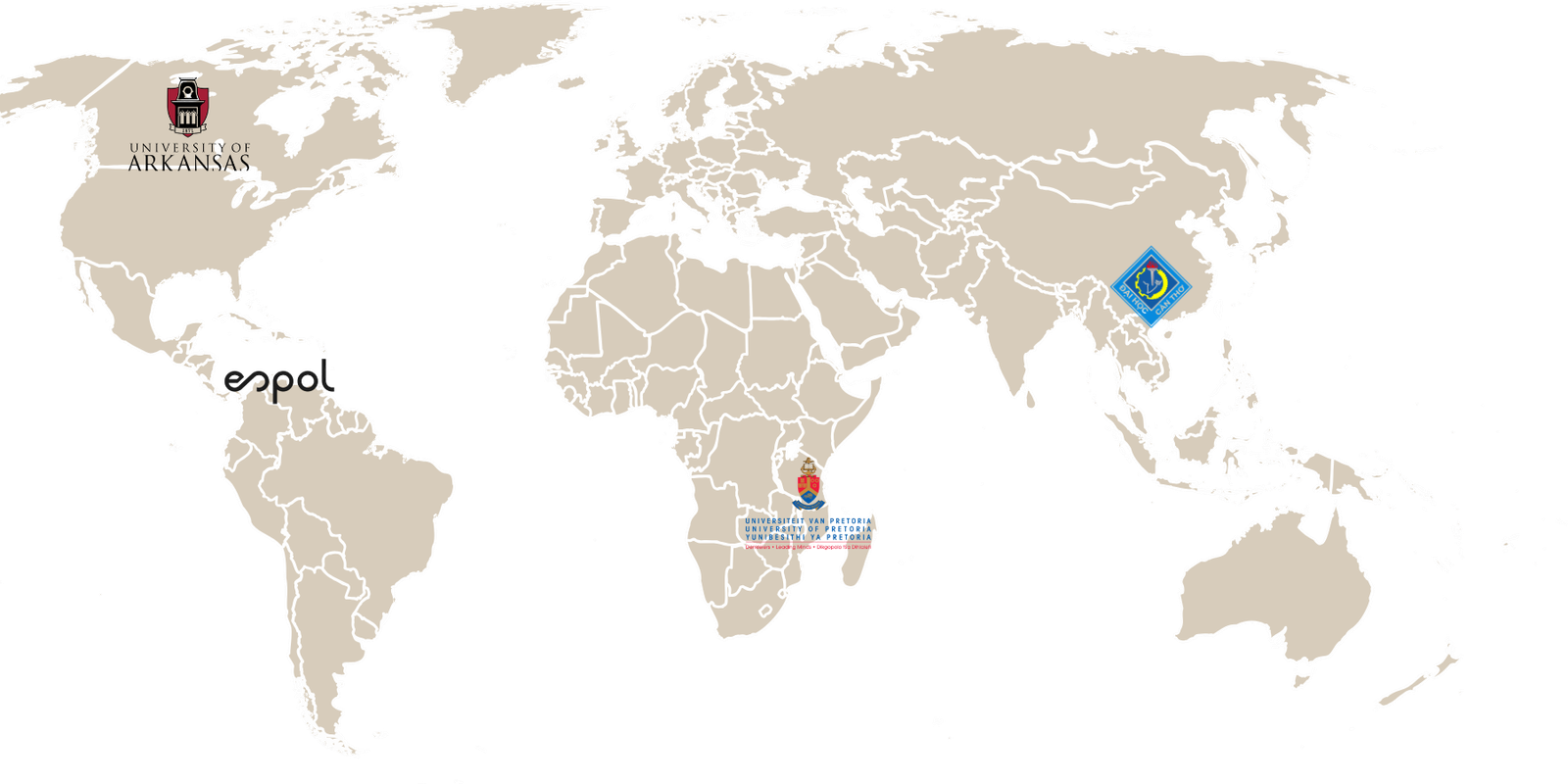
South Africa
Vietnam
United States
Ecuador
Belgium
Ghent University, Belgium
Department of agricultural economics
The department of agricultural economics at Ghent University is part of the Faculty of Bioscience Engineering. It is specialized in education and research related to the economic aspects of agriculture and food. Both in education and research, the entire chain ‘from farm to fork’ is taken into account from a socio economic point of view. The different domains of expertise include : Farm management, agricultural policy and rural environmental economics ; Agro-food marketing and consumer behavior; Agribusiness marketing and management; Rural Development Economics; Modelling and Optimisation of Decisions in Economics, Resources, Nature and Agriculture and Economics and management of natural resources.
Coordination
Course coordinator: prof.dr.ir Stijn Speelman
Technical coordinator: Lien Bertrem
The main research interests of professor Speelman lie in the socio-economic aspects of the interactions between humans and natural resources in developing countries. Focus areas are evaluating the efficiency and sustainability of the resource use outcomes, analyzing how management policies affect the relationship between actors and natural resources, investigating the role of the institutional settings in sustainable resource management and valuation of ecosystem services. In terms of methodologies, extensive expertise with choice modeling has been built up.
Ghent University is the coordinating institute for the IMRD programme
Contact
imrd@ugent.be
Spain

University of Cordoba, Spain
The Universidad de Córdoba (UCO) has a long-standing tradition of supporting the development of rural areas both nationally and internationally. It ranks highly in global Agriculture and Agri-food rankings due to its strong expertise in world-class training and research, emphasising innovative research, practical knowledge transfer, and talent development. A key strength is UCO’s leadership and active involvement in the International Campus of Excellence in Agri-food (ceiA3), which connects universities, businesses, and public bodies to promote innovation in agriculture, food systems, and rural development, including dedicated initiatives on several emerging topics such as digital tools, circular bioeconomy, and nature-based solutions.
The pool of academics and researchers involved in IMRD is a multidisciplinary team with diverse backgrounds and extensive expertise, firmly engaged in advancing knowledge and conducting both theoretical and applied research in Rural Development.
UCO is also well-positioned to promote the adoption of innovation among rural SMEs and farms through collaborative R&D and transfer mechanisms with companies, helping to move solutions from labs to field applications and local value chains. Simultaneously, it contributes to skills and employability in rural areas through various activities aimed at boosting development by establishing an effective bridge between university capabilities and rural dwellers, administrations and organisations. UCO’s strong involvement in agro-rural innovations and digital training aligns with national priorities to modernise the sector and enhance capacities in rural communities, thereby strengthening long-term competitiveness and resilience.
Coordination
Local coordinator: Prof. Dr. ir. María del Mar DELGADO SERRANO
Professor Delgado-Serrano is a senior Lecturer with more than 25 years of working experience in rural areas, sustainability, links between social and natural systems, social and human aspects of environmental challenges, natural resource management, commons and community-based management, sustainable governance of natural resources, resilience, agriculture digitalization, local perceptions and links between rural and urban areas.
Contact
Coordinator: mmdelgado@uco.es
Germany

Humboldt-Universität zu Berlin, Germany
Thaer-Institute for Agricultural and Horticultural Sciences
At Humboldt-Universität zu Berlin, students can deepen their understanding in the institutional, political and economical aspects of rural development and related topics. The IMRD is located at the Department of Agricultural Economics of the Thaer-Institute for Agricultural and Horticultural Sciences. The key staff includes renowned professors and researchers of various disciplines: Agricultural and food policy, resource economics, management of agrarian value chains, agricultural development and trade and farm management that together with other colleagues provide extensive expertise for teaching in this track of specialization. For more information on the research done at the Thaer-Institute click here.
Coordination
Local coordinator: Dr. Pascal Grohmann
Dr. Pascal Grohmann is postdoctoral researcher at the Agricultural and Food Policy Group of Humboldt-Universität zu Berlin, Germany. His research focuses on European agricultural policy, especially with links to environmental policy, policy instruments, policy mixes, and related questions of the exercise of power and its legitimacy implications.
Contact
pascal.grohmann@hu-berlin.de
Slovakia
Slovak University of Agriculture, Nitra
Faculty of European Studies and Regional Development
The coordinating team at Slovak University of Agriculture in Nitra (SUA) is composed of staff from different chairs with expertise and long-term experience in the field of rural and regional development issues, agricultural policy and with topics related to the environment and natural resources. This interdisciplinary approach provides students with complex studies in the field of rural and regional development and agricultural policy, respecting the 2030 Agenda for Sustainable Development and Sustainable Development Goals, especially No poverty, Gender equality, Affordable and Clean Energy, Decent Work and Economic Growth, Reduced inequalities, Responsible Production and Consumption and Climate action. See the full overview of research done at the faculty.
Coordination
Local coordinator: prof. Ing. Pavol Schwarcz, PhD.
Management: doc. Ing. Loreta Schwarczová, PhD.
Technical coordinator: Ing. Norbert Floriš, PhD.
prof. Ing. Pavol Schwarcz, PhD. is professor at Chair of European Studies and Public Administration. He provides students with lectures on agricultural and regional policy. He is the promotor of both doctoral and master students. He is also a Jean Monnet Centre of Excellence grant holder. As an investigator, he coordinated and was involved in several national and international research and educational projects. He is an author and a co-author of several scientific publications and books especially focused on the field of agricultural policy.
Contact
General information: imrd@uniag.sk
Coordinator: pavol.schwarcz@uniag.sk
Italy
University of Pisa, Italy
Department of Veterinary Science
The research activity regards different topics: rural development, social innovation, social farming, sustainable local development, quality and promotion of products in the agro-food chain, theoretical and empirical studies on small farmers’ individual and collective strategies, socio-economic impact of sustainable agriculture, support policies for small farming and rural development at local and regional level and alternative strategies in agro-food system.
See the full overview of research done at the department of Veterinary Science.
See the full overview of research done at the department of Agricultural, Food and Agri-environmental Sciences.
Coordination
Local coordinator: Prof.Francesco Di Iacovo
Technical coordinator: Dott. Paola Scarpellini
Francesco Di Iacovo is Full Professor in Agricultural Economics at the Dept. of Veterinary Science, Pisa University.
His research activity focuses on multifunctional agriculture and social farming social sustainability, civic agriculture and development in rural areas, food planning, sustainable animal production, animal-nature based solutions and smart cities, transition, social innovation and governance, and involves public institutions as well as private stakeholders in research-action paths. He coordinated, was WP’ leader and researchers in several EU-projects (SOFAR, COST, INHABIT, UPFARM among the others). He was National Delegate in the COST 866 on Green care. He teaches courses on rural development and transition, agricultural economics and rural policies. During his research activity has published more than 200 among articles and books, both in Italian and in English.
He is local coordinator of the managing board of the ERASMUS MUNDUS-International Master on Rural Development and has been member of many international projects in the frame of Alfa (EU-Latin-America), Socrates and Erasmus initiatives.
Contact
Coordinator: paola.scarpellini@unipi.it
France
The Agro Institute, France
The Agro Institute, The new Higher Education Institution for agriculture, food and environment is an educational institute in Rennes, France, that conducts academic and applied research based on the sustainable development of resources and territories, in close partnership with national and international research organisations. The institute also transfers knowledge to the socioeconomic sector, following 5 thematic areas: Plant, animal, systems; Environmental issues, resources, territories and city; Food and food production; Fishing, sea and coastline and Landscape.
Coordination
Local coordinator(s): prof.dr. Catherine DARROT
Local coordinator(s): prof.dr. Philippe Boudes
Catherine Darrot is a senior lecturer in rural sociology at Agrocampus Ouest and a member of the CNRS (National Center for Scientific Research) “Spaces and Societies” team. Her researches deal with the European trajectories of transition towards local food systems and agroecology, and with the farmers and actors negociations for environmental public goods provisions. She teaches social movements around agroecology, transition towards local food systems, rural development policies in Europe, French farmers social situation and dynamics.
Philippe Boudes is lecturer at Agrocampus Ouest (Rennes, France) and also amember of the CNRS. His background in environmental sociology leads him to work on ecological transition, public goods, conflict and resource management, using social sciences, interdisciplinary and applied approaches. Within Agrocampus Ouest, he represents the ESO CNRS team and the Human Sciences Pedagogic Unit. He is involved in lecture on environmental, rural and general sociology, ecological transition, methodology of social sciences, technical and social changes. Its current research programs focus on river morphological restauration, energy transition carried by citizens and farmers, greening of cities.
Contact
general information: student.mobility@agrocampus-ouest.fr
coordinator: catherine.darrot@agrocampus-ouest.fr
South Africa
University of Pretoria, South Africa
Department of Agricultural Economics, Extension and Rural Development
The department is concerned with the application of management and economic principles to solve practical problems in the food and agricultural industry. The research programmes and outputs are geared towards answering current business and policy issues in the food and agricultural industry, in South Africa and beyond.The academic programmes, in turn, prepare the next generation of well-rounded agricultural economists to become leaders in the food and agricultural industry.
The main programmes or fields of expertise, led by experienced researchers within the department, are:
- Agribusiness Management
- Food and Agricultural Policy
- Agricultural Extension
- Agricultural and Rural Development
- Environmental Economics and Policy
Visit the website for more information on the research of the Department of Agricultural Economics, Extension and Rural Development.
Department coordination
Local coordinator: Dr. Danie Jordaan
Danie Jordaan trained in Agricultural Economics, Agribusiness Management and Project Management and works as an agribusiness and value chain specialist and academic in the rural development context. Based in the University of Pretoria in South Africa Danie’s current activities include undertaking agribusiness and value chain research in a range of local and international research projects. Danie’s key skills include research and teaching in Agribusiness Management and Value Chain analysis in a rural development setting.
University of Pretoria is a partner in the VLIR track of the IMRD programme
Contact
danie.jordaan@up.ac.za
Vietnam

Can Tho University, Vietnam
Mekong Institute
The Mekong Institute (MI) is an interdisciplinary training and research organization of Can Tho University (CTU). The mission of the Institute is to improve the quality of life of people and ensure the sustainable development of the Mekong Delta. It offers three master programmes (i.e. Agricultural Systems, Rural Development, and Public Policy) and one doctoral programme (i.e. Rural Development). Strong research clusters of the Institute are agro-biological diversity management, agro-food systems, agricultural and resource economics, rural-urban interactions, rural livelihoods, regional and sub-regional planning.
MI is located in the main Campus of CTU at the centre of Can Tho city, the heart of the Mekong Delta of Vietnam. Here, IMRD students will get opportunities to apply what they learn in class for a real situation at one of typically tropical monsoon wetland ecosystems and of the biggest food production areas in the world.
Coordination
Local coordinator: Assoc. Prof. Dr. Nguyen Thanh Binh
Assoc. Prof. Dr. Nguyen Thanh Binh is an IMRD alumni (batch 2006-2008). Currently, he gives lectures in farming system, agricultural extension, project planning, participatory tools, livelihood analysis and vulnerability assessment for students in Can Tho University.
Can Tho University is a partner in the VLIR track of the IMRD programme
Contact
General information/administration: Ms. Le Van Thuy Tien (lvttien@ctu.edu.vn)
Coordinator: Assoc. Prof. Dr. Nguyen Thanh Binh (ntbinh02@ctu.edu.vn)
United States

University of Arkansas, USA
Department of Agricultural Economics and Agribusiness
The Department of Agricultural Economics and Agribusiness at the University of Arkansas offers graduate programs of study leading to the Master of Science (M.S.) degree in Agricultural Economics. Advanced study in Agricultural Economics and Agricultural Business provides students with state of the art knowledge of theory, methods and application in the field. Students obtain enhanced knowledge and skills to manage the dynamic environment of contemporary agribusiness and production agriculture. Research expertise cover: Food and Agricultural Marketing; Food Policy Economics; Agricultural Policy; International Trade and Development; Agricultural Finance and Risk Management; Regional/Rural Economic Development; Agribusiness Management; Resource and Environmental Economics; Production Economics; and is home of the Fryar Price Risk Management Center of Excellence.
For more information on the department’s research, visit the Department Research page. Find details about faculty and staff research and teaching expertise on the Expertise page.
Coordination
Local coordinator: prof.dr. Bruce Ahrendsen
The University of Arkansas is a partner in the IMRD+ ATLANTIS programme
Professor Ahrendsen is a leader in international education and has been involved with the IMRD+ATLANTIS Double Degree Programme since its inception in 2008. The IMRD+ATLANTIS Programme allows students to earn two degrees: the International Master of Science in Rural Development joint degree signed by all six European Union Partners and the Master of Science in Agricultural Economics degree awarded by the University of Arkansas.
Contact
ahrend@uark.edu
Ecuador

Escuela Superior Politécnica del Litoral, Ecuador
Faculty of Social Sciences and Humanities
The Faculty of Social Sciences and Humanities at the Escuela Superior Politécnica del Litoral (ESPOL) aims to contribute to the comprehensive education of professionals with a strong foundation in social, economic, and human sciences, promoting critical thinking, applied research, and a commitment to sustainable societal development.
Its academic approach focuses on understanding and transforming territorial, economic, and social dynamics, fostering interdisciplinarity and maintaining strong linkages with productive sectors and local communities. The faculty promotes knowledge generation at the service of society, with a particular emphasis on rural development, public management, applied economics, and sustainability.
Department coordination
Local coordinator: Ángel Severo Flor Pineda, MSc.
Professor Emeritus MDR:Ramón L. Espinel, PhD.
Profile of MSc. Ángel Severo Flor Pineda
Ángel Severo Flor Pineda is a researcher, academic manager, and rural development specialist affiliated with ESPOL, where he serves as Deputy Director of the Center for Rural Outreach and Research (CIR) and coordinator of graduate programs in rural development.
He has extensive experience in the design, coordination, and implementation of research, outreach, and consultancy projects in rural territories, working collaboratively with local governments, international organizations, and productive communities. His work focuses on strengthening smallholder agriculture, agricultural traceability systems, food security, territorial development, and the promotion of local economies.
He has led and coordinated high-impact initiatives at provincial and national levels, including projects in strategic territories such as the Galápagos Islands. His approach integrates technical, economic, and social perspectives, promoting evidence-based decision-making processes.
He is recognized for his leadership in multidisciplinary teams, institutional coordination, and the development of strategic alliances, contributing to effective knowledge transfer and the design of sustainable solutions for rural development.
Profile of PhD. Ramón L. Espinel
Dr. Ramón L. Espinel is an Emeritus Professor at the Escuela Superior Politécnica del Litoral (ESPOL) and a leading academic in the field of agricultural economics and rural development, with an extensive career in both academia and international public service.
He holds a degree in Agricultural Engineering from the University of Guayaquil, a Master of Science in Agricultural Economics from the Pontifical Catholic University of Chile, and a PhD in Agricultural and Resource Economics from the University of California, Berkeley.
Throughout his career, he has held high-level public positions, including Vice Minister of Trade and Minister of Agriculture of Ecuador (2009–2011), as well as serving as Ecuador’s representative on the Board of Directors of the International Monetary Fund (IMF) in Washington, D.C.
In academia, he has been a visiting professor at prestigious international institutions such as Ghent University (Belgium), Agrocampus-Ouest and the University of Rennes (France), Humboldt University of Berlin, and the University of Florida (United States).
Currently, as an Emeritus Professor at ESPOL, he continues to contribute actively to graduate education – particularly in the Master’s Program in Rural Development – bringing his expertise in research, public policy, and international cooperation.
Contact
General information: aflor@espol.edu.ec
Coordinator: aflor@espol.edu.ec