
Careers and testimonials
Careers
Time to first job
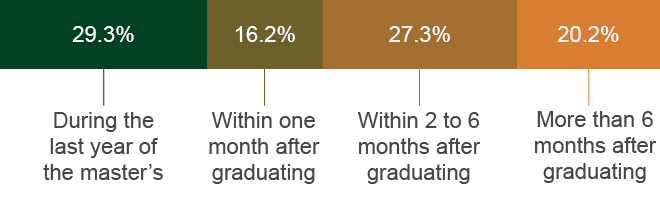
Research among IMRD graduates since the programme’s inception shows that more than 70% of the graduates found a job within six months after graduation. 30% of those even found a job during the final master’s year.
Career paths
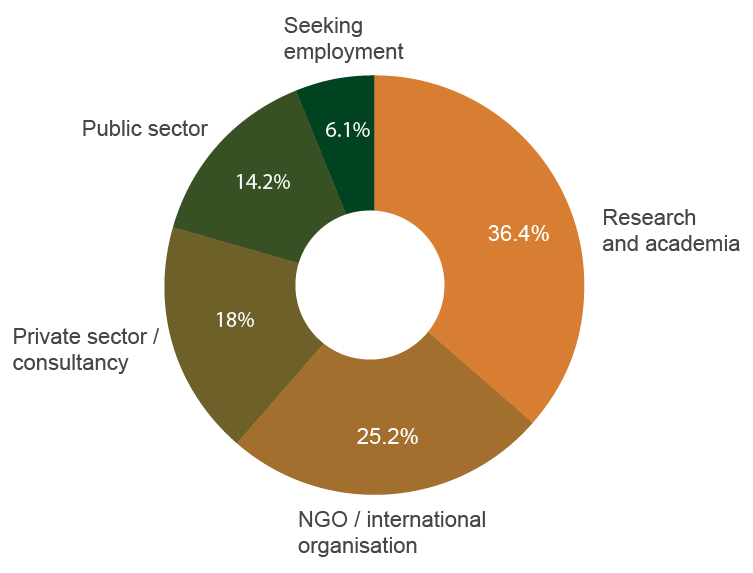
The same research shows that 36% of the IMRD graduates are working as researchers or in academia, 25% are employed by non-profit, non-governmental, or international organisations, 18% are self-employed, in private companies, consultancy, or other jobs and 14% are working in public services.
Testimonials
Tianlin Gao, China, graduated in 2024
“My IMRD journey exceeded all my expectations. Studying in Belgium, Slovakia, South Africa, and Italy allowed me to delve into diverse rural development contexts. My time at Ghent University was particularly rewarding – an institution known for its academic excellence, where I was challenged and supported by professors who genuinely cared about our growth as both students and individuals. The flexibility in thesis selection, along with the strong support from my supervisors, allowed me to further explore my passion for sustainable development.
The lifelong friendships with colleagues from over 20 countries are what I value the most. The mobility gave me a clearer understanding of the environments I thrive in and what is essential for my life. The city of Ghent itself, vibrant and youthful, offered a perfect backdrop with its lively culture, music, and of course, the beers.”
Professor Dr. Md. Kamrul Hasan, Bangladesh, graduated in 2016
“My global career orientation was seeded during my IMRD studies across Ghent University (Belgium), Humboldt University (Germany), and Slovak University of Agriculture (Slovakia). Diverse contents—including research methodology, data analysis, development policy, economics, climate science and sociology—greatly broadened my knowledge to address the challenges of my current role as a full professor at Patuakhali Science and Technology University.
Professor dr. ir. Marijke D’Haeses care for research, along with rigorous training in statistics and econometrics using R, paved my path to achieving a PhD in Ecosystem Management. Currently, I confidently teach statistics, machine learning and agricultural extension, and supervise master’s and PhD research concerning the improvement of rural livelihoods in a changing climate. Students can access the learning materials at ruenresearch.com. The welcoming multicultural environment of Ghent is very comfortable for international students. The IMRD degree was my dream, and the programme has given me more than I ever imagined.”
Jens Van Hee, Belgium, graduated in 2023
“Joining the IMRD programme means studying alongside bright minds from all over the world. Together, you work and collaborate on a wide range of subjects and global case studies, from agricultural policy and economics to rural development and sociology. Everyone brings their own background, stories and motivations to the programme, leading to class discussions that never bore. The best part of this Master’s, though, is undoubtedly the friendships you build along the way, the adventures our IMRD group shared, and the cultural immersion that comes with studying in different European cities.
Professionally, IMRD also opened doors for me. While studying at Humboldt University of Berlin, I conducted my Master’s thesis research at the Leibniz Centre for Agricultural Landscape Research (ZALF), which involved collecting data on the cocoa sector in Côte d’Ivoire. This allowed me to directly apply what I had learned, from participatory and economic research methods to agroecological principles and scientific communication. This experience paved the way for my current position as a Junior Officer with Veterinarians Without Borders and Enabel in Benin, where I promote the adoption of agroecological and green economy practices among smallholder farmers.
Overall, IMRD encouraged me to critically reflect on global food systems from different perspectives — policy, economics and society — and complemented my previous Master’s degree in Bioscience Engineering Technology in Tropical Agriculture extremely well.”