
Programme
Programme objective
The IMRD programme prepares graduates to become forward thinking professionals capable of shaping the future of rural areas. Students develop a deep understanding of the challenges rural regions face and the essential role they play in solving wider societal issues.
Graduates learn how to analyse rural transformations, design sustainable strategies, foster innovation and collaborate effectively with diverse stakeholders to support inclusive rural development. They will be equipped to work in roles across policy, consultancy, research and local development, contributing to vibrant, connected and resilient rural areas worldwide.
Structure IMRD programme
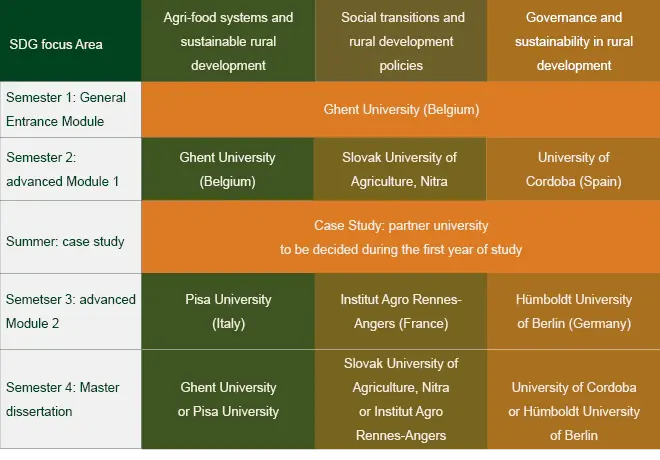
The first semester, the general entrance module, offers theoretical formation in basic agricultural economics, development theories and methodologies. Its courses represent a general training into basic competence domains.
Semester 2 and 3 offer specialisations in one of the three focus areas:
- Agri-food systems and sustainable rural development
- Social transitions and rural development policies
- Governance and sustainability in rural development
Students follow obligatory and optional courses, which can be complemented with elective courses for broadening specific knowledge or to improve language/cultural knowledge and skills.
In between semester 2 and 3, students take part in a practical experience of a specific Case Study, organised by one of the IMRD partners. Students from diverse backgrounds get to explore the reality of rural development through active learning methods, sharing visions and discussing opinions.
The IMRD programme is completed with a master dissertation in semester 4. This dissertation (thesis) is based on own scientific and practical research with guidance of a supervisor and is written in one of the disciplines of rural development.
VLIRUOS
IMRD is currently a VLIRUOS funded programme. Students studying with a VLIRUOS scholarship follow a slightly different study programme. Mid Octoberer 2026 it will be clear whether this funding will be extended. In that case, the specific VLIRUOS study programmes will also be outlined here.

Double degrees
It is possible for IMRD students to earn a double degree. In this case, students will receive the joint IMRD degree in addition to a local national degree of the double degree programme.
IMRD students can earn a degree in Agricultural Economics after completing their second year at the University of Arkansas (United States). Master’s students in Agricultural Economics at the University of Arkansas can earn the joint IMRD degree by completing two semesters at two different EU IMRD partner universities.
The aim of the Eerudev programme is for IMRD students to experience and compare rural development in Europe and in Ecuador. By studying their second master year, master dissertation included, at the Escuela Superior Politécnica del Litoral (ESPOL), they can earn the Master of Science in Rural Development degree awarded by ESPOL on top of the joint IMRD degree.